Czech Republic

Regions and Cities at a Glance provides a comprehensive assessment of how regions and cities across the OECD are progressing in a number of aspects connected to economic development, health, well-being and the net zero-carbon transition. It presents indicators on individual regions and cities to assess disparities within countries and their evolution since the turn of the new millennium. Each indicator is illustrated by graphs and maps. The report covers all OECD countries and, where data is available, partner countries and economies.
The data in this note reflect different sub-national geographic levels in OECD countries:
Regions are classified on two territorial levels reflecting the administrative organisation of countries: large regions (TL2) and small regions (TL3). Small regions are classified according to their access to metropolitan areas (Fadic et al. 2019).
Functional urban areas consist of cities – defined as densely populated local units with at least 50 000 inhabitants – and adjacent local units connected to the city (commuting zones) in terms of commuting flows (Dijkstra, Poelman, and Veneri 2019). Metropolitan areas refer to functional urban areas above 250 000 inhabitants.
In addition, some indicators use the degree of urbanisation classification (OECD et al. 2021), which defines three types of areas:
- Cities consist of contiguous grid cells that have a density of at least 1 500 inhabitants per km2 or are at least 50% built up, with a population of at least 50 000.
- Towns and semi-dense areas consist of contiguous grid cells with a density of at least 300 inhabitants per km2 and are at least 3% built up, with a total population of at least 5 000.
- Rural areas are cells that do not belong to a city or a town and semi-dense area. Most of these have a density below 300 inhabitants per km2.
Disclaimer: https://oecdcode.org/disclaimers/territories.html
Regional economic trends
Employment and unemployment rates in regions
In the Czech Republic, regional disparities in unemployment rates are moderate compared to other OECD countries. While in Moravia-Silesia 4.3% of the working force was unemployed in 2022Q2, the share was 1.1% in Central Bohemian Region.
Meanwhile, the difference in employment rate between the regions with the highest (Prague) and lowest (Central Moravia and Moravia-Silesia) employment rates reached 7 percentage points in 2022.
Note: Harmonised employment and unemployment rates, aged 15 and over. The OECD median corresponds to the median employment rate in large regions.
Source: OECD (2022), “Short-term regional statistics”, OECD Regional Statistics (database)
The first year of COVID-19 on GDP per capita
The first year of COVID-19 resulted in a decrease in GDP per capita in all Czech regions. Central Bohemian Region, a region with a GDP per capita -11% below the national average (32 291 vs. 36 095 USD PPP), experienced the largest decrease in GDP among Czech regions, of approximately -9%.
Note: GDP per capita is measured in constant prices and constant PPPs, reference year 2015. Constant prices are calculated using national deflators. The OECD median corresponds to the median decline in GDP per capita observed across OECD large regions over the period.
Source: OECD (2022), “Regional economy”, OECD Regional Statistics (database)
Trends in regional economic disparities in the last decade
Differences between Czech regions in terms of GDP per capita have remained relatively stable over the past nine years, with the richest 20% of regions reporting a GDP per capita 2.3 times higher than the poorest 20% of regions.
Note: The GDP per capita of the top and bottom 20% regions are defined as those with the highest/lowest GDP per capita until the equivalent of 20% of the national population is reached. A ratio of 2 means the richest regions have a GDP per capita twice as large as the poorest regions. The indicator is calculated using large regions, except for Latvia and Estonia, where small regions are used instead. Irish GDP underwent an upwards revision in 2016. Care is advised in its interpretation.
Source: OECD (2022), “Regional economy”, OECD Regional Statistics (database)
Productivity trends in the last decade
Between 2010 and 2019, Central Bohemian Region and Moravia-Silesia experienced the highest and lowest productivity growth in the Czech Republic, respectively. Central Bohemian Region saw a labour productivity increase of 2.5% per year, above the OECD average of 0.9%1. During the same period, Moravia-Silesia experienced more modest growth in measured labour productivity, averaging 0.7% per year.
All Czech regions experienced a decline in labour productivity between 2019 and 2020. Central Bohemian Region experienced the largest decline, with a drop of 6.0%
Note: Regional Gross Value Added (GVA) per worker, in USD, constant prices, constant PPP, base year 2015.
Source: OECD (2022), “Regional economy”, OECD Regional Statistics (database)
Well-being, liveability and inclusion in regions
Regional well-being
The Czech Republic faces stark regional disparities across nine well-being dimensions, with the starkest disparities in terms of civic engagement, income and community.
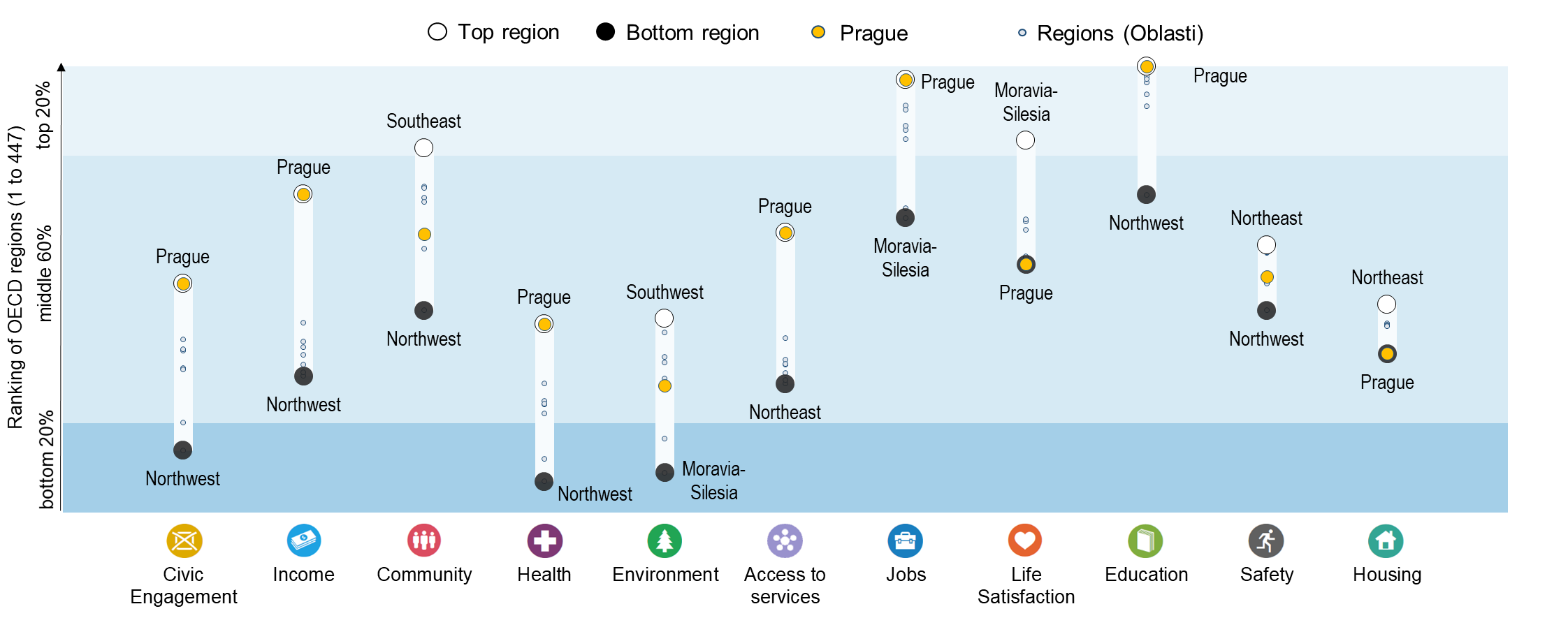
Note: Regional indices provide a first comparative glance of well-being in OECD regions. The figure shows the relative ranking of the regions with the best and worst outcomes in the eleven well-being dimensions, relative to all OECD regions. The eleven dimensions are ordered by decreasing regional disparities in the country. Each well-being dimension is measured by the indicators in the table below.
Relative to other OECD regions, the Czech Republic performs best in the education dimension, with most of Czech regions lying in the top 20% of OECD regions.
The top 20% of Czech regions rank above the OECD median region in 8 out of 14 well-being indicators, performing best in terms of population with at least upper secondary education.
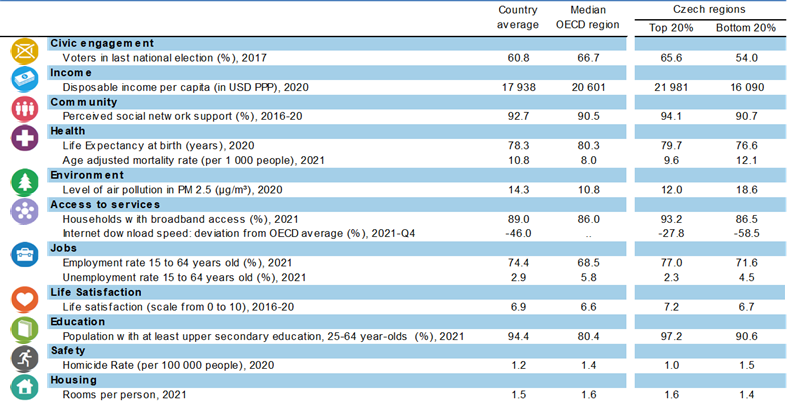
Note: Regional well-being indices are affected by the availability and comparability of regional data across OECD countries. The indicators used to create the indices can therefore vary across OECD publications as new information becomes available. For more visuals, visit https://www.oecdregionalwellbeing.org.
The digital divide
Fixed Internet connections in Czech cities and rural areas deliver speeds significantly slower than the OECD average (-18% and -71%, respectively). This gap (53 percentage points) is larger than in most other OECD countries.
Note: Cities and rural areas are identified according to the degree of urbanisation (OECD et al. 2021). Internet speed measurements are based on speed tests performed by users around the globe via the Ookla Speedtest platform. As such, data may be subject to testing biases (e.g. fast connections being tested more frequently), or to strategic testing by ISPs in specific markets to boost averages. For a more comprehensive picture of Internet quality and connectivity across places, see OECD (2022), “Broadband networks of the future”.
Source: OECD calculations based on Speedtest by Ookla Global Fixed and Mobile Network Performance Maps for 2020Q4.
The average speed of fixed Internet connections is below the OECD average in all Czech regions. Within the country, residents of Prague, Northwest and Southeast experience the fastest connections.
Relative poverty rates
In the Czech Republic, relative poverty rates2 range from 8% to 17% across regions. This 9 percentage point difference is less pronounced than the average difference observed across the 29 OECD countries with available data (16 percentage points).
Note: The OECD median gives the median relative poverty rate observed in a sample made of 326 large regions (from 28 countries), and 28 small regions (from Denmark, Lithuania and the Slovak Republic). Data corresponds to 2020 or the latest available year.
Demographic trends in regions and cities
Population projections by type of regions across OECD countries
Between 2020 and 2040, the population of the Czech Republic is expected to grow in metropolitan regions and decrease in other types of regions. Metropolitan regions are expected to see the greatest change, with their population increasing, on average, by 5 % over the next two decades.
Note: Lines represent the population projection in OECD countries per type of region (Fadic et al. 2019). The Czech Republic is highlighted in blue.
Dependency rate and proportion of the elderly
In the coming two decades, the share of the elderly population in the Czech Republic is expected to increase across all types of regions.
The elderly dependency rate3 in the Czech Republic is also higher than the OECD average (26.8 %) in all regions, ranging from 33.5% in Northeast to 29.1% in Prague.
Population in cities
Between 2010 and 2022, 53% of cities in the Czech Republic experienced a rise in population. Population growth ranged from -0.8% per year in Most to 0.6% per year in Prague.
Note: Cities refer to functional urban areas (Dijkstra, Poelman, and Veneri 2019). The boundaries of functional urban areas correspond to the 2020 Urban Audit. Population counts for the functional urban area are aggregated from administrative, municipal-level, data.
Over the past decade, the population has grown the most in Czech cities with more than 1.5 million inhabitants. Cities with 50 000 to 100 000 inhabitants have seen their population shrink, on average.
Environmental challenges in regions and cities
Greenhouse gas emissions in regions
Since 1990, production-based greenhouse gas emissions have decreased in most Czech regions. Northwest (2%) and Moravia-Silesia (-63%) experienced the largest increase and decrease in emissions, respectively.
On average, Czech regions decreased their emissions by 1.62% per year between 1990 and 2018. This is below the 1.93% yearly reduction rate needed to reach the EU target of a 55% reduction in emissions by 2030, with respect to 1990 levels.
Note: Bubbles are proportional to per capita greenhouse gas emissions, not to the overall level of greenhouse gas emissions in the region.
Source: OECD calculations, based on the Emissions Database for Global Atmospheric Research (European Commission. Joint Research Centre. 2019).
In 2018, greenhouse gas emissions per capita in the Czech Republic were largest in Northwest, Central Bohemian Region and Moravia-Silesia. Power accounts for the largest share of greenhouse gas emissions in the three regions.
Note: Regions with low population counts may rank high in greenhouse gas emissions per capita while contributing relatively little to overall emissions in the country.
Urban heat island effect
In Czech cities, the difference in temperature between cities and their surrounding areas (i.e. urban heat island intensity) reaches 2.6 degrees Celsius (°C). The largest effect is observed in Liberec and Ceske Budejovice, two cities that are, on average, 3.5°C and 4.2°C warmer than their surrounding areas, respectively.
Note: The Urban Heat Island Intensity (UHI) index is defined as the difference in land surface temperature between built-up areas and non-built-up areas within functional urban areas. This index can be affected by the type of vegetation and climate in non-built-up areas.
Source: OECD calculations, based on land surface temperature data from NASA’s Moderate Resolution Imaging Spectroradiometer (MODIS) (Wan, Hook, and Hulley 2021a, 2021b)
References
Source of administrative boundaries: © OECD, © EuroGeographics, National Statistical Offices, © UN-FAO Global Administrative Unit Layers (GAUL)
Footnotes
International comparability in 2019 and 2020 is limited because of methodological differences in the calculation of employment counts during the height of the COVID-19 economic crisis.↩︎
The relative poverty rate gives the share of people – as a % of the regional population – with an income below the relative poverty line (60% of the national median income).↩︎
The elderly dependency rate compares the number of elderly people at an age when they are generally economically inactive (i.e. aged 65 and over), to the number of people of working age (i.e. 15-64 years old).↩︎